Vigabatrin liquid vs powder vs tablets
On this page
Short answer: the ready-to-use liquid (Vigafyde, 100 mg/mL) removes the mixing step that every powder dose needs, halves the volume of each dose, and keeps for 90 days once opened. In the one study that compared them directly, caregivers measured the liquid far more accurately than doses mixed from powder. That study was small and funded by the liquid's maker, and the liquid is labeled only for infantile spasms in babies 1 month to 2 years old.1,2
All three forms contain the same medicine. Vigafyde was approved by comparing its composition with vigabatrin powder solution, so its benefits and risks, including the vision-loss warning, are the same.1 The differences are practical, but for a medicine given twice a day to a baby, practical differences add up.
| Feature | Ready-to-use liquid | Powder sachets | Tablets |
|---|---|---|---|
| Before each dose | Draw up the dose. No mixing.1 | Empty 1–3 packets into a cup, dissolve each in 10 mL of water, then draw up the dose.3 | Swallow the tablet.4 |
| Strength | 100 mg per mL | 50 mg per mL once mixed (500 mg packet in 10 mL) | 500 mg tablet, scored |
| One maximum dose for a 10 kg infant | 7.5 mL | 15 mL, mixed from 2 packets; 5 mL thrown away | Not used for infants |
| After opening | Bottle keeps 90 days at 2–30 °C | Mix fresh for every dose and discard what is left | Store in the bottle |
| FDA-labeled for | Infantile spasms, 1 month to 2 years | Infantile spasms (1 month–2 years) and refractory complex partial seizures (2 years and up) | Refractory complex partial seizures, 2 years and up (infants are dosed with oral solution) |
| Handling (NIOSH) | No packets to open or tablets to crush.5 | Powder is poured out and dissolved at every dose | Crushing or splitting raises exposure5 |
Ready-to-use liquid
Powder sachets
- Before each dose
- Empty 1–3 packets into a cup, dissolve each in 10 mL of water, then draw up the dose.3
- Strength
- 50 mg per mL once mixed (500 mg packet in 10 mL)
- One maximum dose for a 10 kg infant
- 15 mL, mixed from 2 packets; 5 mL thrown away
- After opening
- Mix fresh for every dose and discard what is left
- FDA-labeled for
- Infantile spasms (1 month–2 years) and refractory complex partial seizures (2 years and up)
- Handling (NIOSH)
- Powder is poured out and dissolved at every dose
Tablets
- Before each dose
- Swallow the tablet.4
- Strength
- 500 mg tablet, scored
- One maximum dose for a 10 kg infant
- Not used for infants
- After opening
- Store in the bottle
- FDA-labeled for
- Refractory complex partial seizures, 2 years and up (infants are dosed with oral solution)
- Handling (NIOSH)
- Crushing or splitting raises exposure5
What happens before each dose
Powder sachets. The label tells caregivers to empty each 500 mg packet into a clean cup, dissolve it in 10 mL of cold or room-temperature water, check that the solution is clear, draw up the prescribed volume, give it right away, and throw away the rest.3 Doses up to 500 mg need one packet and 10 mL of water; doses up to 1,000 mg need two packets and 20 mL; doses up to 1,500 mg need three packets and 30 mL. The same steps apply to Vigadrone and other generic powders.6 The Sabril label asks prescribers to confirm that caregivers understand how to mix it and give the right dose.3
That routine happens twice a day, every day. For a 5 kg baby starting treatment, each 125 mg dose uses a whole 500 mg packet, and 7.5 mL of the mixed solution (375 mg) is thrown away each time.3
Ready-to-use liquid. The label says Vigafyde "does not require additional reconstitution or dilution." The dose is drawn straight from the bottle with a calibrated oral syringe.1
Tablets. Tablets are swallowed. They are used for refractory complex partial seizures from age 2; babies with infantile spasms are dosed with an oral solution.4
Dose accuracy: what the evidence shows
The direct comparison
A 2025 study asked 30 people (15 experienced vigabatrin caregivers and 15 people who had never used an oral syringe) to prepare one dose of 1,125 mg from the ready-to-use liquid and one from Sabril powder, using only the written instructions.2
- Ready-to-use liquid
- Mixed powder
Within 10% of the target dose
Within 2% of the target dose
30 people, one 1,125 mg dose of each. Small study funded by the liquid’s maker.
Show as a table
| Group | Measure | Value |
|---|---|---|
| Within 10% of the target dose | Ready-to-use liquid | 100% |
| Within 10% of the target dose | Mixed powder | 77% |
| Within 2% of the target dose | Ready-to-use liquid | 70% |
| Within 2% of the target dose | Mixed powder | 20% |
- Ready-to-use liquid: all 30 doses were within 5% of the target. About 70% were within 2%.
- Powder: 23 of 30 doses (77%) were within 10%. Doses ranged from 425 mg to 1,390 mg, that is, from 62% too little to 24% too much. About 20% were within 2%.
- On average the liquid delivered 99% of the intended dose and the powder 90%.
- People measured the volumes of both products equally well. The errors came from mixing the powder.
- Experienced caregivers did no better with the powder (10 of 15 within 10%) than first-time users (13 of 15).
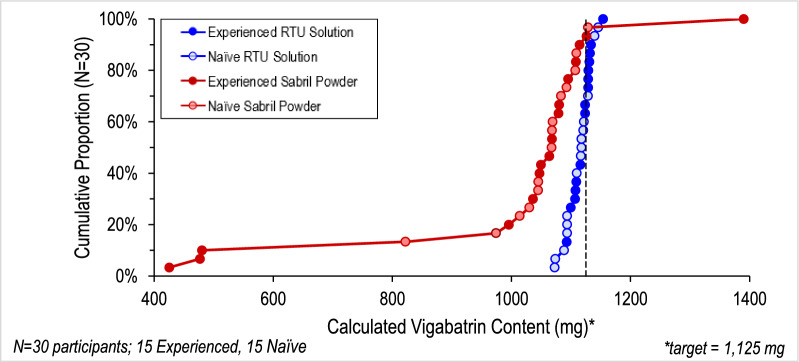
Limits of this study. The authors worked for the company that makes Vigafyde. It was small, each person made a single dose in a test setting, and the target dose (22.5 mL of powder solution) was larger than a typical infant dose. People could not ask questions, which the authors note is not how the label expects caregivers to be taught. No study has compared seizure outcomes between the two forms.2
Why measuring liquid medicine at home is hard in general
Independent research on children's liquid medicines points the same way. In a trial of 2,110 parents, 84% made at least one dosing error and 21% gave more than double the intended dose at least once, even without any mixing step.7 Errors were lowest when the syringe size matched the dose: for a 7.5 mL dose, a 10 mL syringe used once worked better than a smaller syringe refilled.8 Parents of children with complex medical needs felt confident (81 to 99%), yet only 55% measured two doses correctly.9 The American Academy of Pediatrics notes that errors are most common with liquid medicines and complicated schedules, and that children with chronic conditions are affected most.10
Mixing adds a second chance for error before measuring even starts. In a study of a reconstituted antibiotic, most participants skipped the "shake before use" step, and the doses they measured differed from the intended dose.11 Splitting tablets is also imprecise: across 13 studies, split tablets were acceptably even only 55% of the time.12 These studies were not about vigabatrin, but they describe the same steps.
Why accuracy matters early in treatment
With infantile spasms, the first weeks count. In a national cohort, babies who responded to vigabatrin did so in a median of 3 days, and experts advise reassessing any baby who has not responded within a week.13 Longer delays to effective treatment and failure to stop spasms early are linked to worse development later.14,15 In vigabatrin's own trial, higher doses stopped spasms more often than low doses.16 A dose that comes out 10% or 60% short during that window is not a small matter. This link is indirect: no study has tied the choice of formulation to a baby's outcome.
Doses that come out too high matter too. Brain MRI changes in infants have been linked to higher peak doses in some studies, though not in all.17,18
Volume per dose
The liquid is twice as concentrated as mixed powder, so every dose is half the volume.1
Ready-to-use liquid, 100 mg/mL
7.5 mL
Drawn straight from the bottle. Fits in one 10 mL oral syringe.
Mixed powder, 50 mg/mL
15 mL
Two packets dissolved in 20 mL of water; 15 mL is given and 5 mL is thrown away. More than one 10 mL syringe-full.
Scale marks every 1 mL, 0–20 mL. Volumes from the FDA dosing tables for each product. Twice daily.
- Ready-to-use liquid, 100 mg/mL
- Mixed powder, 50 mg/mL
3 kg
5 kg
10 kg
Show as a table
| Group | Measure | Value |
|---|---|---|
| 3 kg | Liquid | 2.25 mL |
| 3 kg | Powder | 4.5 mL |
| 5 kg | Liquid | 3.75 mL |
| 5 kg | Powder | 7.5 mL |
| 10 kg | Liquid | 7.5 mL |
| 10 kg | Powder | 15 mL |
Smaller volumes are easier to give to a baby, but very small volumes are harder to measure: syringes become less accurate below about 0.1 mL.19 Ask the pharmacy for a syringe that matches your baby's dose.
Storage and waste
An opened bottle of Vigafyde is kept at 2 to 30 °C and thrown away 90 days after opening.1 Mixed powder, by label, is made fresh for every dose and the remainder discarded.3 A 2025 lab study by a generic powder maker found that mixed powder stayed stable for 48 hours in the fridge in water, juice, milk or formula, but the approved labels have not changed.20
Handling and exposure
Vigabatrin is on the federal NIOSH list of hazardous drugs because of possible harm to pregnancy and development.21 NIOSH guidance for healthcare workers says that crushing tablets or opening capsules should be avoided and that "liquid formulations should be used whenever possible."5 That guidance is written for workplaces, not homes, and NIOSH still advises gloves for staff giving any oral liquid. At home, the practical point is simple: the liquid involves no powder to pour or tablets to crush. See safe handling.
Trade-offs and limits
- Switching needs care. The same number of mL of the liquid gives twice the dose of mixed powder. The label warns prescribers, pharmacists and caregivers to check the volume when switching.1
- Label scope. The liquid is labeled only for infantile spasms in babies 1 month to 2 years old. It is not approved for refractory complex partial seizures or for adults.1
- Same medicine, same risks. No formulation changes the risk of vision loss, the REMS requirements, or the MRI findings in infants.
- The evidence is thin. One small, manufacturer-funded study compares the forms directly. The broader research on dosing errors supports the same conclusion but was not about vigabatrin.
- Cost and coverage vary. Insurance coverage differs between products; see cost.
Who the ready-to-use liquid is for
The liquid is designed for babies with infantile spasms between 1 month and 2 years old, the group in which doses change with weight, volumes are small, and the first weeks of treatment matter most.1 Older children and adults with refractory complex partial seizures use tablets or powder. If your baby is on powder now, ask the prescriber whether the ready-to-use liquid is an option. Use the dose calculator to see label volumes for each form.
Common questions
Is Vigafyde the same medicine as Sabril powder?
Yes. Both contain vigabatrin. Vigafyde was approved based on how its composition compares with vigabatrin powder for oral solution, not on new efficacy trials, so its effects and risks, including vision loss, are the same.
Can I switch my baby from powder to the ready-to-use liquid?
Only with the prescriber. The liquid is twice as concentrated (100 mg/mL vs 50 mg/mL), so the same dose is half the volume. Giving the old number of mL of the new liquid would double the dose. The prescriber and pharmacist should give you the new volume in writing.
Can the ready-to-use liquid go through a feeding tube?
The Vigafyde label allows it to be given by mouth or through a gastrostomy (G) tube. With a GJ tube, use the G-port. Flush the tube with water afterward.
How long does an opened bottle of Vigafyde last?
After first opening, keep it at 2 to 30 °C (36 to 86 °F) and throw it away 90 days after opening. Unopened bottles are stored at room temperature.
Is the liquid approved for older children or adults?
No. Vigafyde is labeled only for infantile spasms in babies 1 month to 2 years old. People with refractory complex partial seizures use tablets or powder.
References
- 1.VIGAFYDE (vigabatrin) oral solution prescribing information, revised 11/2025. Source
- 2.Gibson R, Klima R, Van Horn J. Liquid Medication Dosing Errors: Comparison of a Ready-to-Use Vigabatrin Solution to Reconstituted Solutions of Vigabatrin Powder for Oral Solution. Adv Ther. 2025;42(3):1484-1493. PMID 39899223 · DOI 10.1007/s12325-024-03089-0 · PMC11868180 (Epub Feb 2025; often cited as 2024) PubMed · DOI
- 3.SABRIL (vigabatrin) for oral solution prescribing information, revised 10/2021. Source
- 4.SABRIL (vigabatrin) tablets prescribing information, revised 10/2021. Source
- 5.NIOSH. Managing Hazardous Drug Exposures: Information for Healthcare Settings. Hodson L, Ovesen J, Couch J, et al. DHHS (NIOSH) Publication No. 2023-130, April 2023. DOI 10.26616/NIOSHPUB2023130 DOI
- 6.VIGADRONE (vigabatrin) for oral solution, revised 12/2025, Upsher-Smith. Source
- 7.Yin HS, Parker RM, Sanders LM, et al. Liquid Medication Errors and Dosing Tools: A Randomized Controlled Experiment. Pediatrics. 2016;138(4):e20160357. PMID 27621414 · DOI 10.1542/peds.2016-0357 PubMed · DOI
- 8.Yin HS, Parker RM, Sanders LM, et al. Pictograms, Units and Dosing Tools, and Parent Medication Errors: A Randomized Study. Pediatrics. 2017;140(1):e20163237. PMID 28759396 · DOI 10.1542/peds.2016-3237 PubMed · DOI
- 9.Blackmer AB, Fox D, Arendt D, et al. Perceived Versus Demonstrated Understanding of the Complex Medications of Medically Complex Children. J Pediatr Pharmacol Ther. 2021;26(1):62-72. PMID 33424502 · DOI 10.5863/1551-6776-26.1.62 PubMed · DOI
- 10.Yin HS, Neuspiel DR, Paul IM, et al. Preventing Home Medication Administration Errors. Pediatrics. 2021;148(6):e2021054666. PMID 34851406 · DOI 10.1542/peds.2021-054666 PubMed · DOI
- 11.Neves I, Auxtero MD. Dosing Accuracy of Oral Extemporaneous Suspensions of Antibiotics: Measuring Procedures and Administration Devices. Pharmaceutics. 2021;13(4):528. PMID 33920192 · DOI 10.3390/pharmaceutics13040528 PubMed · DOI
- 12.Eserian JK, Lombardo M, Chagas JR, Galduróz JCF. Actual Versus Expected Doses of Half Tablets Containing Prescribed Psychoactive Substances: A Systematic Review. Prim Care Companion CNS Disord. 2018;20(1):17r02211. PMID 29469240 · DOI 10.4088/PCC.17r02211 PubMed · DOI
- 13.Yuskaitis CJ, Mytinger JR, Baumer FM, et al. Association of Time to Clinical Remission With Sustained Resolution in Children With New-Onset Infantile Spasms. Neurology. 2022;99(22):e2494-e2503. PMID 36038267 · DOI 10.1212/WNL.0000000000201232 PubMed · DOI
- 14.O'Callaghan FJ, Lux AL, Darke K, et al. The effect of lead time to treatment and of age of onset on developmental outcome at 4 years in infantile spasms: evidence from the United Kingdom Infantile Spasms Study. Epilepsia. 2011;52(7):1359-1364. PMID 21668442 · DOI 10.1111/j.1528-1167.2011.03127.x PubMed · DOI
- 15.O'Callaghan FJK, Edwards SW, Alber FD, et al. Vigabatrin with hormonal treatment versus hormonal treatment alone (ICISS) for infantile spasms: 18-month outcomes of an open-label, randomised controlled trial. Lancet Child Adolesc Health. 2018;2(10):715-725. PMID 30236380 · DOI 10.1016/S2352-4642(18)30244-X30244-X) PubMed · DOI
- 16.Elterman RD, Shields WD, Mansfield KA, Nakagawa J; US Infantile Spasms Vigabatrin Study Group. Randomized trial of vigabatrin in patients with infantile spasms. Neurology. 2001;57(8):1416-1421. PMID 11673582 · DOI 10.1212/wnl.57.8.1416 PubMed · DOI
- 17.Hussain SA, Tsao J, Li M, et al. Risk of vigabatrin-associated brain abnormalities on MRI in the treatment of infantile spasms is dose-dependent. Epilepsia. 2017;58(4):674-682. PMID 28230253 · DOI 10.1111/epi.13712 PubMed · DOI
- 18.Sathe R, Shrestha G, Terango A, et al. Symptomatic vigabatrin-associated MRI toxicity is associated with simultaneous hormonal therapy among patients with infantile spasms. Epilepsia Open. 2025;10(1):314-320. PMID 39570186 · DOI 10.1002/epi4.13099 PubMed · DOI
- 19.Arenas-López S, Gurung K, Tibby SM, et al. Accuracy of enteral syringes with commonly prescribed paediatric liquid medicines. Arch Dis Child. 2017;102(7):655-659. PMID 28235838 · DOI 10.1136/archdischild-2016-312492 PubMed · DOI
- 20.Zachman M, Gong L, An L, Halvorsen MB. Dissolution and stability of vigabatrin powder in water, fruit juice, milk, and infant formula. Epilepsy Behav Rep. 2025;31:100816. PMID 40838171 · DOI 10.1016/j.ebr.2025.100816 PubMed · DOI
- 21.NIOSH. NIOSH List of Hazardous Drugs in Healthcare Settings, 2024. Ovesen JL, Sammons D, Connor TH, et al. DHHS (NIOSH) Publication No. 2025-103, December 2024 (supersedes 2016-161). DOI 10.26616/NIOSHPUB2025103 · DOI